Showing posts with label Castles. Show all posts

Marbles


A collection of marble sculptures inside the newly refurbished wing of the Schloss Charlottenburg. I recently saw a performance of Mozart's greatest hits in one of the upper rooms. It was a real treat to see the palace "after hours" and the musicians were really talented, especially the soprano. Hopefully there will be other performances to enjoy in the future!

Egyptian influence


You'll find some visitors from North Africa in the Langhans Hall inside Schloss Bellevue. This room is used to receive visitors and where new ambassadors are formally received. 

I hope you've enjoyed this short tour of the Schloss Bellevue. If you're interested in seeing more, there is a brochure you can download here.

Dresden from the Left Bank


This painting of the Elbe in Dresden is by Italian artist Bernardo Bellotto. It is on display in the President's office in Schloss Bellevue. While each President has some freedom to decide which works will be displayed throughout the residence, this is one of the permanent works.

Golden room


This is the grand ballroom where state dinners are held. At one end of the room is this beautiful, golden painting; the other end has a similar piece with more pinkish tones. Both were grand pieces of art which fit the room. They were painted by German artist Gotthard Graubner.

Crystal


One of the beautiful grand chandeliers from inside Schloss Bellevue. Unfortunately, none of the original furnishings or decorative items survived the war. Luckily other palaces and museums from around the country have loaned items from the period.

A look inside


The Schloss Bellevue has only been used by Germany's President since 1994. During the divided years, the President worked at the Hammerschmidt Villa in Bonn (the former capitol of West Germany). The palace was originally used as a hunting lodge by the Prussian royalty. It suffered quite a bit of damage during WWII, but luckily was preserved.


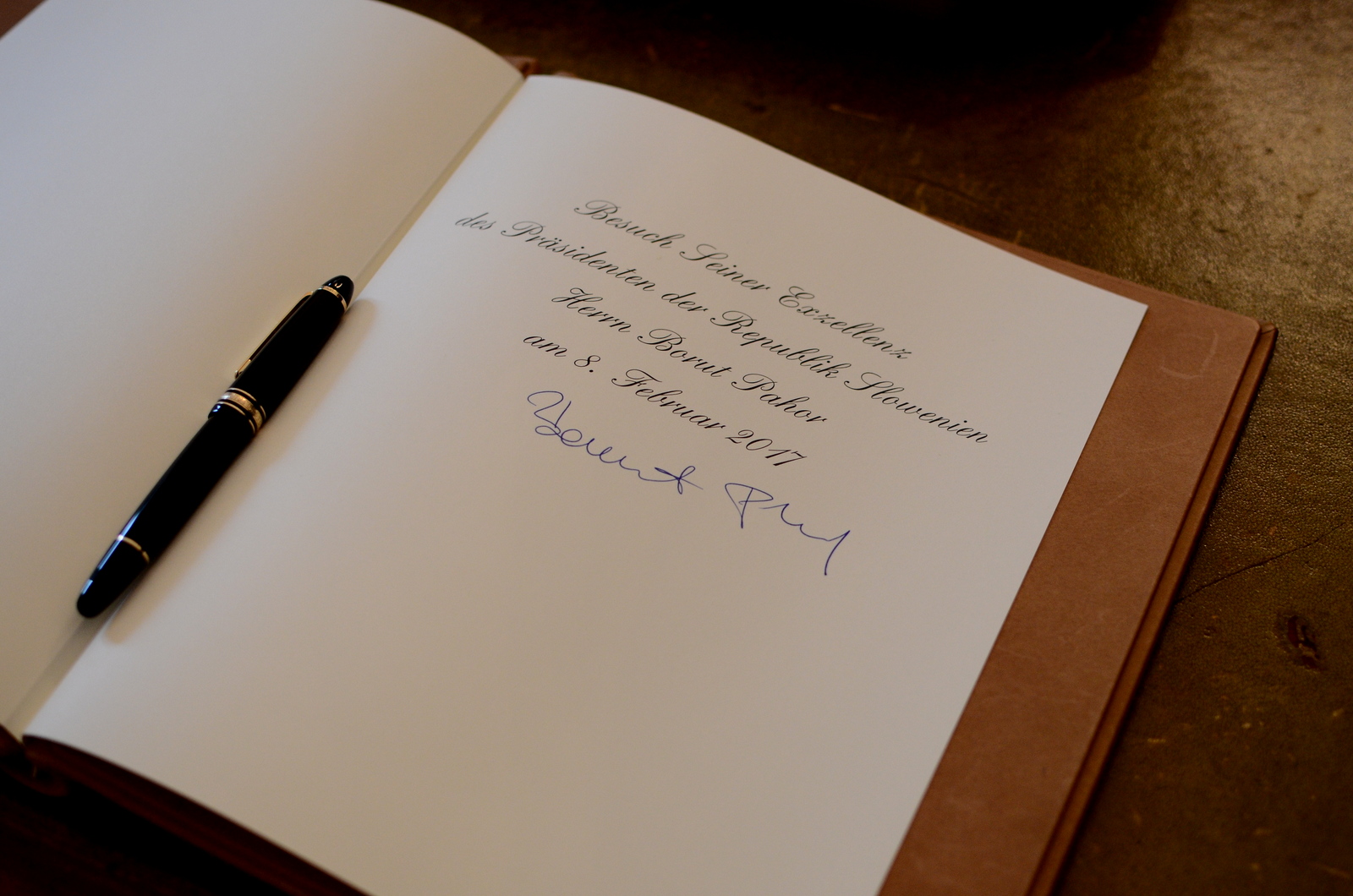
Today the President of Germany has his offices here. He also hosts state dinners and other events for foreign dignitaries onsite. Each elite visitor signs a special page in the guest book. The President of Slovenia had just visited a few days before I was there.

Schloss Bellevue


The Schloss Bellevue is the building where the German president works and hosts visiting foreign dignitaries. I was lucky enough to be invited on a tour of the building and grounds recently (it is not open to the public) and I saw his personal study and the many rooms he uses for entertaining. Stay tuned for more!

Spiraling up


It is perhaps difficult to tell from this photo, but this is the staircase that takes you to to the top of the Juliusturm at Zitadelle Spandau. It was interesting that the stairs were against the walls of the tower instead of being right in the center. It was quite the walk up, though I find coming down is often worse! For more treasures, take a look at Tuesday Treasures.

Der Juliusturm


The Juliusturm (Julius Tower) is the oldest part of the Citadel, it dates back to a fortress that was on the site as early as 1200. A trip up to the top is one of the highlights of a visit to Spandau. On a clear day, you can see quite a ways and you easily understand the defensive nature of its position at the confluence of the Spree and Havel.


Though it was a bright day, it wasn't sunny and it was pretty cold and windy. I couldn't stay up top for very long, but I got a few snaps of the view. This is a view onto part of the moat which ensured the safety of Citadel in the old days.


And here's a look into the city center of Spandau. You may remember the church tower from yesterday's model. I hope you've enjoyed your week at the Citadel. For more reflections, visit Weekend Reflections.


The Prussian Eagle and other things


The Zitadelle Spandau has become a repository for relics from the Prussian days. Before Germany was a federal republic, it was divided into kingdoms and duchies. Prussia was one of the bigger and more powerful of them. The Prussians rulers were known for their political savvy and built their empire over the years through both marriage and military means.

Unfortunately, the Prussian history is linked with military aggression and a monarchy who was out of touch with the people. For this reason, many of the old busts and statues of Prussian rulers were removed from their public places. You can see some of them here at the Citadel along with many other historical items, like this Eagle of the Prussian empire.

I don't recall the historical significance of this desk, but I like the way the light is hitting it, making the wood seem to glow.


This gun and the accompanying papers reveal the fate of military deserters.


Lastly, it's hard for me to resist a shot through a doorway, especially when the light is so perfect. Hope you've enjoyed the tour so far, I'll show some of the Heimatmuseum of Spandau tomorrow. Until then, there are more signs at Signs, Signs.

The one-eyed count


Meet Count Rochus Graf zu Lynar, the Italian architect who designed and built Zitadelle Spandau. Though he looks like he's winking in this portrait, it's just the one-eyed count's way of saying hello. He lost an eye in the Battle of Saint Quentin in France, after which he concentrated his efforts on other pursuits, like building fortresses. He was a shrewd builder and planner - the Zitadelle is built on the confluence of the rivers Havel and Spree and has four tall bastions that make it impossible for anyone to approach the site without being seen. 

The Museum inside is part showcase for all things Prussian and part Heimatmuseum (hometown museum for Spandau). 


Here's a selection of ceremonial helmets that were worn by elite members of the Prussian Military. There were quite a few of them on display.


Some had interesting symbols.


Others were over-the-top ornate. It couldn't have been very comfortable to wear such headgear, I'm sure it is very heavy.

I hope you'll stop by again tomorrow. We'll skip the rest of the military stuff and take a look at some of the more interesting items in the Prussian section of the museum. I'm linking this post with Tuesday Treasures.

Spandau Citadel


As promised, this week we're taking a tour through the Spandau Citadel. It's always good to start with a full-frontal of the building itself. The Citadel was completed in 1594 and is built at the crossroads of the rivers Havel and Spree, making it a perfect defensive spot. Today the Citadel hosts a Heimatmuseum. I hope you'll stop by again tomorrow for a look inside.

The Humboldtforum


The facade of the new City Palace will look just like the old Prussian castle that once stood here. However, the inside will be modern with much of it belonging to the Humboldt University. The rest of the building will be used as an exhibition space to house some of Berlin's art collection which has no permanent home at the moment.

This model inside the Humboldt Box clearly shows how the Humboldtforum will look once complete. The palace will face the Spree river with a view on the Lust Garten to the right. Just below the park is the Berliner Dom. 

It's a very exciting project and will certainly draw a lot of attention when complete, the grand opening is scheduled for 2019. I hope to get back then!

Architectural details


The Humboldt Box is a showcase for the soon-to-be-finished Stadtschloss. It is designed after the original Prussian palace that stood on these grounds until after WWII when the DDR razed it and built the Palast der Republik in its place.

This is a look at one of the original decorative pieces that has been cast in plaster to show visitors to the Box what some of the interiors will look like. There has been some controversy around the rebuilding of such an important Prussian symbol - people either love it or hate it. Count me as one of the lovers, I can't wait until it's complete!

I'll be showing more from the Humboldt Box this week, hope you'll stop by. I'm linking this post with Tuesday Treasures.

Hall of mirrors


There's also a beautiful Hall of Mirrors inside the Schloss Charlottenburg. I was lucky to visit on a beautiful, sunny October day, perfect for catching some reflections of the windows that give out onto the gardens I showed you yesterday.


Though most of the pieces and decorations in the Schloss are not original, they have tried to source items that are from that era. I really loved this beautiful chandelier.


It also looks neat from below. Hope you have enjoyed this week's tour through the Schloss Charlottenburg. Happy Friday everyone! And don't forget to take a look at Weekend Reflections.

Schloss gardens


Looking back at how green the gardens were in October makes me long even more for the beginnings of spring. The gardens at the Schloss Charlottenburg were inspired by those at Versailles. There is some similarity, don't you think? Though certainly, nowhere near as grand!

Signs of wealth


Beautiful details abound in every room of Schloss Charlottenburg. The Emperors and Royals  who called this place home certainly didn't spare anything when it came to showing their wealth.

The horse crest seen here represents the coat of arms of the Duchy of Saxony, which was made up of the present day states of Saxony, Lower Saxony and Saxony-Anhalt. The crest was probably added after the marriage of Augusta of Saxony to Wilhelm I of Prussia to symbolize the unity of the two German states. For more signs, take a look at Signs, Signs.

Hall of portraits


The Schloss Charlottenburg only recently reopened after extensive renovations. It has been beautifully restored and decorated and is definitely worth a visit, if you're in the city. I'll show you more details from inside the halls and chambers throughout the week.
 

Until then, enjoy this portrait of Sophie-Charlotte, the queen consort the palace was named for. I'm also linking this post with Tuesday Treasures.

Horse and rider


May I introduce you to Friedrich Wilhelm, also known as The Great Elector. He was the ruler of Prussia from 1640 until his death in 1688. He was a great military leader and political strategist, as well as a staunch supporter of the protestant church. His likeness can be seen all around Berlin, but this statue is particularly notable as it stands in front of the Schloss Charlottenburg. 

I was lucky to get this shot on a blue-sky day and you can see more skies of all kinds at Skywatch. 

Merry Christmas!


This creche is from the Schloss Charlottenburg Christmas Market. It's one of the biggest and prettiest in Berlin and they always have a nice manger scene. These figures were handmade by a local chainsaw artist. I always wonder how they can get so much detail with a chainsaw.

Enjoy the rest of your Christmas, hopefully surrounded by friends, family and those you love.
Related Posts Plugin for WordPress, Blogger...